
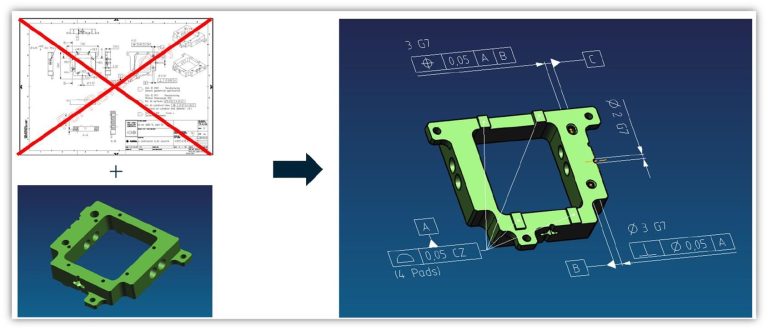
Model-Based Engineering (MBE)
- Many downstream applications (such as programming CNC milling machines) already use 3D models or STEP files, where tolerances and other product information must be entered manually.
- In Model-Based Engineering information currently found on 2D drawings is embedded in 3D models.
- Because this information (also known as "Product and Manufacturing Information" (PMI)) is machine-readable, programming CNC machines (CAM) and measuring equipment (CAI) can be extensively automated.
- This is not possible with information on 2D drawings!
- MBE supports and forces engineers to deliver high-quality and reviewed technical product documentation.
- Artificial Intelligence ("AI") will accelerate digitization but requires complete and standardized data: MBE provides this.
- In Europe the implementation of MBE is proceeding slowly, partly because most suppliers still require 2D drawings.
- Further development of MBE requires feedback from CAD, CAM, and CAI users.
- For manufacturing companies to evaluate and to process 3D PMI, 3D CAD software is overkill.
- Free 3D viewers are not user-friendly and have limited functionality. Advanced 3D viewers fill this gap.
The benefits of MBE.
- Faster time-to-market: 20-50% reduction in lead time from engineering to production.
- Lower costs: fewer design changes, fewer iterations, less rework, fewer errors on the shop floor.
- Automated checks regarding Design for Manufacturing improve the quality of the designs.
- Suppliers receive better designs (reviewed 3D models incl. PMI).
- More efficient workflows for downstream applications (minimal manual data entry required).
The future of MBE (in combination with a.o. AI and rule-based software).
- Automatically generate PMI, a.o. by comparing with comparable parts.
- Enrich 3D geometries (e.g. step) automatically with PMI from 2D drawings.
- Check whether the PMI can be read and processed by CAM and CAI systems.
- Automatically review manufacturability (using PMI as additional input alongside geometries).
- Automated generation FMEAs during product development, and 8D reports in case of problems.
- Predictive process control during production (a.o. based on current and historical measurements).
- Streamlining / repairing data exchange between various CAD, CAM, and CAI formats (internally, between sites, with customers and suppliers)